They came to Jerusalem from far away: Christians in search of the sites of the Gospels, Muslims drawn by the sanctity of Al-Aqsa, Jews longing to touch the stones of the Temple’s ruins. What led them to make the pilgrimage, and what did they find when they arrived? These are the questions at the heart of a new series at Beit Avi Chai by Dr. Eyal Davidson, a senior lecturer, tour guide, and author whose work focuses on the history of Jewish settlement in the Land of Israel.
“The Road to Jerusalem: Reading the Travel Diaries of the Holy Land” explores a genre that sits at the crossroads of history, theology, and travel writing – the medieval pilgrimage diary. Drawing on accounts left by Jewish, Christian, and Muslim travellers from the Byzantine period through the Mamluk era, Davidson illuminates how they understood the city, how they negotiated its shared sacred spaces, and how what they found compared to what they had imagined.
Physical hardship and squalor
Medieval pilgrimage accounts contained disappointment alongside devotion. The Jerusalem of the pilgrim’s imagination – radiant, exalted, the navel of the world – often collided with a very different reality. “During the Middle Ages, Jerusalem was extremely poor, dirty, partially destroyed as a result of wars,” Davidson explains. “Its economic situation was very difficult because of its location and lack of resources. This naturally led to disappointment.” The Jerusalem these travellers entered had been impacted by centuries of conquest by the Persians, Muslims, and Crusaders. Each transfer of power left its mark on the city.
The pilgrims were not put off by physical hardship or squalor though. “For believers it was a high point of their life,” Davidson notes. “They scratched their names into stones as a way of expressing their belonging to the place. They were even willing to risk their lives for the journey, which was especially dangerous during the Middle Ages.” To be physically present in Jerusalem, to pray where Jesus had stood, to mourn at the ruins of the Temple, or to prostrate oneself at al-Aqsa – this made the journey worth it.
The holiness of Jerusalem
What emerges from reading these accounts together is the extent to which the three Abrahamic faiths shared not only geography but a spiritual heritage. “The monotheistic faith and the recognition of the holiness of Jerusalem – even if each expresses it differently,” Davidson observes of what the travellers held in common. “All of them want to be present, whether through settlement or building or pilgrimage to the holy sites.”
This shared heritage is most visible on the Mount of Olives, which Davidson treats as a test case for how medieval travellers and religious traditions negotiated the same sacred space. For Christianity, the Mount of Olives is the place where Jesus ascended to heaven. For Judaism, rabbinic tradition teaches that the Shekhinah, the divine presence, departed from Jerusalem after the destruction of the Temple by withdrawing to the Mount of Olives, and that it will return to the city the same way. “The stories may be different,” Davidson notes, “but these are common ideas.”
Islam, too, integrated Jerusalem’s sacred topography into its own theological imagination. The development of Islamic climate philosophy – which reached its peak between the VIII and X centuries – gave Jerusalem a cosmological rationale for its sanctity. “They developed many important philosophies and explained religious values via philosophy,” Davidson explains. “One was the idea that the world is divided into environmental areas – with extreme climate on the edges, hot and cold – and this influences the nature of people living there.” According to this approach, Jerusalem occupied the precise midpoint of the inhabitable world (also reflected in maps from the period), making it not merely historically or scripturally significant but geographically predestined for holiness. “This was also common in Jewish philosophy during this time,” Davidson notes, another example of intellectual traffic crossing communal boundaries.
The first Jewish traveller who wrote a travel diary
Among travellers who left written accounts, one figure dominates. Benjamin of Tudela, a XII-century Jewish merchant from northern Spain, journeyed through the Mediterranean world and the Middle East between approximately 1165 and 1173, recording what he saw in a remarkable Hebrew diary that survives to this day. He was, as Davidson emphasizes, a pioneer: “Benjamin of Tudela is the first Jewish traveller who wrote a travel diary – before him they were mostly Christian or sometimes Muslim.”
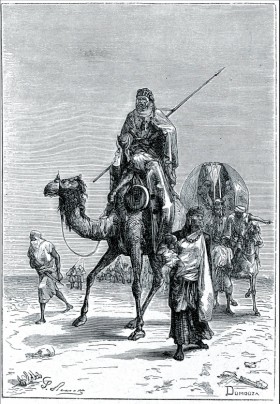
Benjamin of Tudela in the Sahara, in the XIIth century \ Wikipedia
Benjamin wrote at a time when most of the Land of Israel was in Crusader hands – a reality that placed Jews in a position of intense vulnerability and marginalization within their most sacred landscape. “He reveals the Land of Israel in the Crusader period, which we didn’t know much about from a Jewish perspective,” Davidson explains. “He’s the first to give us real historical details about Jews in the Land of Israel during this time.”
Benjamin’s diary is also distinctive in its method. Where many pilgrimage accounts are filtered through devotional conventions – catalogues of shrines, records of miracles, exhortations to fellow believers – Benjamin writes as an observer. He counts, estimates, describes. He records the number of Jews he found in each community, their trades and their leaders, the state of the sites he visited. It is a text that combines pilgrimage literature with ethnographic reportage, its hybrid character making it irreplaceable.
Unfortunately, most medieval travel diaries have not survived. “It’s true that we don’t have many,” Davidson acknowledges. Those that remain represent only a fraction of what was written, which in turn represents only a fraction of the journeys that were made. Most pilgrims left no written record. Some who wrote left texts that were not copied and did not survive. The genre of the pilgrimage diary was always, therefore, an elite document produced by a literate minority reflecting on an experience shared by thousands who were silent.
An appreciation of place
The gap between the surviving literature and the lived experience of pilgrimage is revealing. The relatively few journals we have are “really important for explaining why people came and what they saw,” Davidson notes, but they require careful handling as historical sources. A medieval pilgrim’s account of the sites they visited tells us as much about the literary conventions of their tradition, the expectations of their audience, and the theological framework through which they interpreted their experiences, as it does about the physical reality they encountered.
As a Jerusalem tour guide himself, Davidson brings to these texts not only academic inquiry but also an appreciation of place. Asked where he feels the presence of these early travellers most vividly, he replies: “I feel Jewish travellers most deeply and the longing for the period of the Second Temple and the redemption – both on the Temple Mount and in general.” In this sense, the continuity between the longings of medieval travellers and the city’s inhabitants today is clear.
For more, see Dr. Eyal Davidson’s online series at BAC, “The Road to Jerusalem: Reading the Travel Diaries of the Holy Land” (in Hebrew).
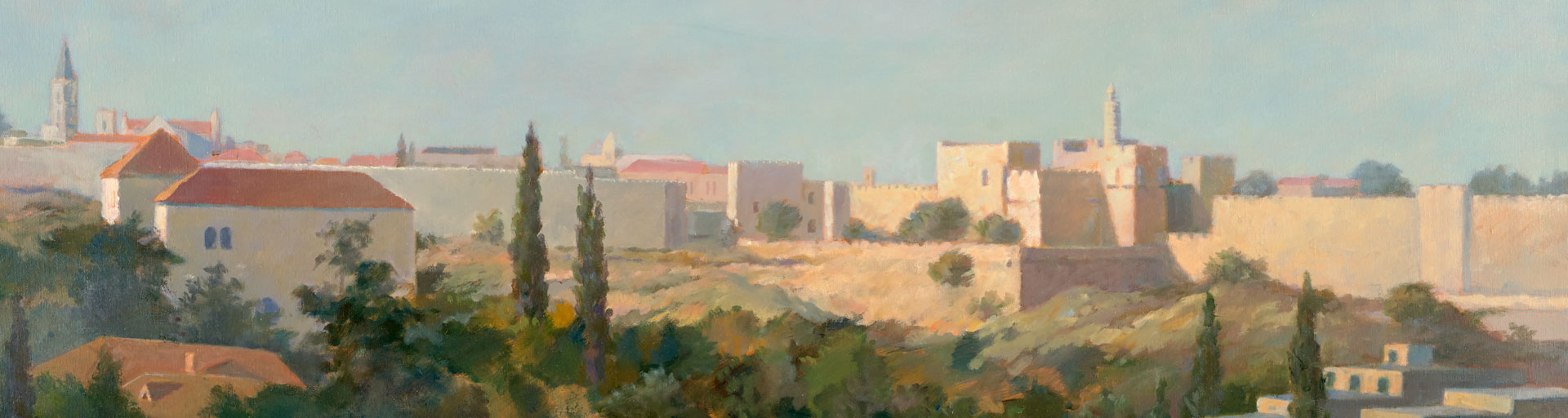
Main Photo: View of Jerusalem from southeast, showing city walls, the Dome of the Rock, and al-Aqsa mosque.\ Wikipedia.
Model.Data.ShopItem : 0
11