Standing tall over the Sea of Galilee lies the volcanic plateau of the Golan Heights. Although mentioned occasionally in ancient sources, for years it remained largely absent from the grand narrative of Jewish life in the Land of Israel. Instead, the focus was on places like Tiberias and Tzippori in the Galilee, centers of rabbinic learning with rich documentary records. The Golan, meanwhile, languished in obscurity.
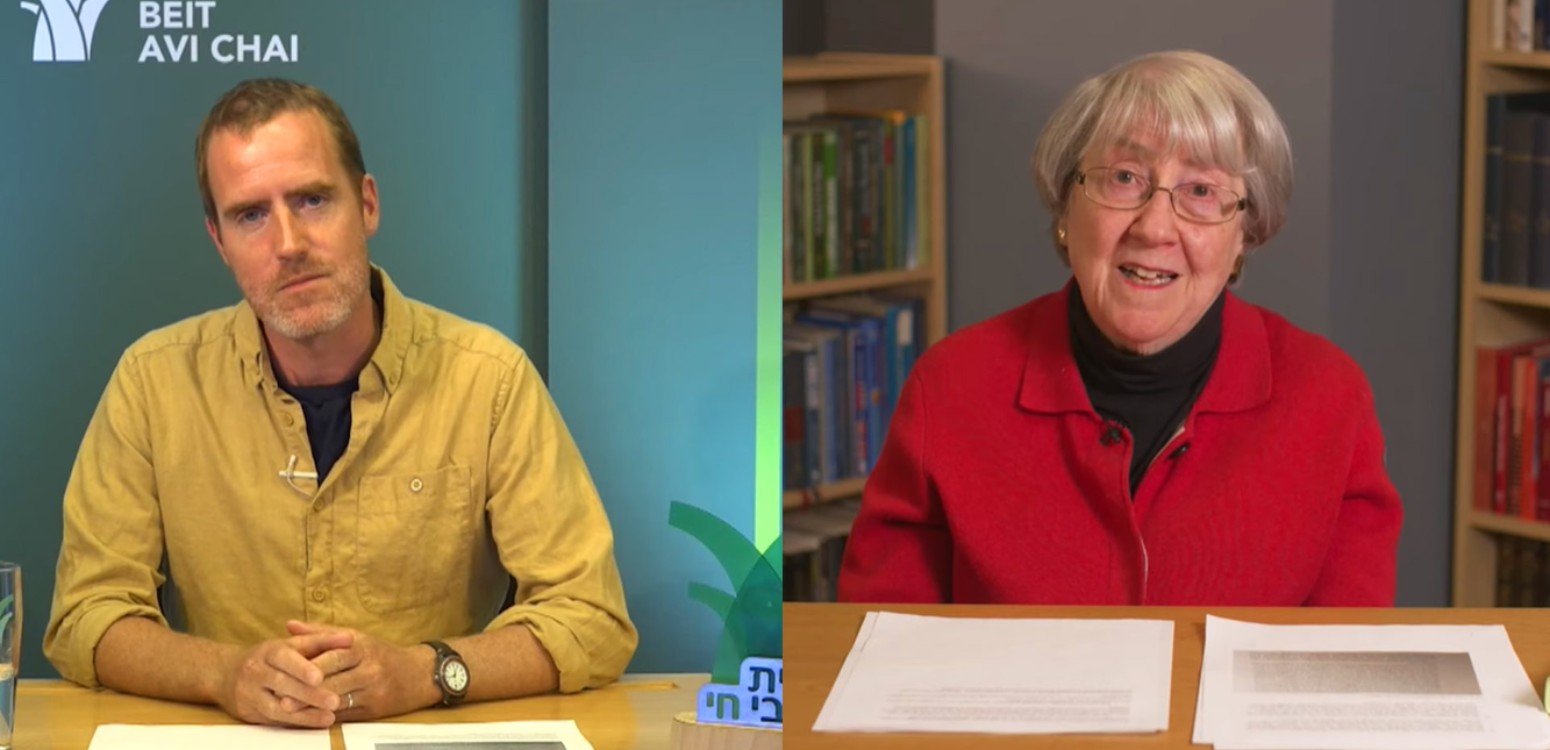
“There are very few historical sources on the Golan, and few rabbinic sources that clearly relate to the Golan, unlike Tiberias and Tzippori, which have both,” explains Dr. Mechael Osband, who teaches Land of Israel Studies at the Kinneret College and also works at the Zinman Institute of Archaeology at the University of Haifa. “In the Golan the focus is much more archaeological.”
Gamla, Katzrin and Umm el-Qanatir
In “Jewish Life in the Golan,” his lecture series at Beit Avi Chai, Osband reveals how surveys and excavations since 1967 have uncovered an unexpectedly vibrant area of Jewish settlement – complete with monumental synagogues, pottery, and trade networks – that thrived for centuries in this challenging landscape.
Before 1967, knowledge of Jewish life in the Golan was fragmentary at best. “We knew there were some synagogues there, but only two of them had been described in detail,” Osband notes. Scholars didn’t even know the location of Gamla, one of the major sites of the Great Revolt against Rome, which Josephus described in vivid detail.
This situation changed after 1967, when archaeologists were able to survey ancient Jewish settlement across the region for the first time, and excavations at major sites like Gamla, Katzrin, and Umm el-Qanatir (Ein Keshatot) took place. “Being able to map the major Jewish presence in the central Golan and the more limited presence in the southern Golan has been crucial,” Osband explains. “Gamla is still one of the main sites, both of the revolt and of daily life, but it’s limited – it goes from the Hasmoneans to the Great Revolt, and then comes to an end. The central Golan tells us the story of the later years.”
Pottery offers a window into daily life
Why, though, did Jews choose to settle in the Golan at all? The region is agriculturally challenging, with a rocky landscape and limited water sources. According to Osband, it was the result of Hasmonean expansion. “It seems to coincide with the conquests by Alexander Yannai,” he explains, referring to the conquests by the Hasmonean king in the late II and early I centuries BCE.
The area may have been relatively empty, creating opportunities for Jewish settlement near the established Jewish community of the Galilee. But settlement patterns were uneven. “The northern Golan was already inhabited by Itureans,” Osband explains. “The southern Golan also had a non-Jewish population.” Thus, the central Golan became the heartland of Jewish life in the area for the following centuries.
If the historical sources are scarce and rabbinic literature largely silent about the Golan, how can we understand the pattern of daily life there? The answer lies in one of archaeology’s most abundant and revealing finds: pottery. “Pottery offers a window into daily life that we don’t get from monumental buildings,” Osband explains. “It also tells us about trade.” Analysing pottery fragments from different sites reveals unexpected patterns. Jewish sites traded with Sussita, a major non-Jewish city close to the Sea of Galilee, while sites farther away developed more local economies. “Jews exported to non-Jewish sites but generally not vice versa,” Osband concludes. “They also import from the Galilee, but again not vice versa.” The Golan was economically integrated with the Galilee to the west, importing pottery from workshops there, but the relationship was asymmetric. The Golan was peripheral, dependent on the Galilee as a source of goods and perhaps even cultural and religious authority. “Historical sources wouldn’t cover these issues,” Osband points out. Pottery workshops, trade between villages, the flow of goods – these everyday realities can only be uncovered through archaeology.
Ancient synagogues
Perhaps nothing illustrates the archaeological revolution in Golan studies more dramatically than the discovery of synagogues. The Golan has the highest concentration of ancient synagogues in Israel – more than 25 have been identified. “They are better preserved in the Golan because the area was more sparsely settled,” Osband explains. Unlike the Galilee, which saw continuous settlement, many Golan sites were abandoned and left relatively undisturbed for centuries, which is why it was possible to nearly fully restore the ancient synagogue at Umm el-Qanatir.
The sheer number of synagogues also reflects the existence of a Jewish population with the resources to build monumental public buildings. These weren’t simple structures. Many Golan synagogues, dating from the III to the VIII centuries (in addition to the first-century Gamla synagogue), were highly decorated and built entirely from basalt – the local volcanic stone. They also made extensive use of the menorah as a decorative motif, more so than Galilean synagogues.

Umm el-Qanatir by Yaelsh23
Greek and Aramaic inscriptions
Architecturally, Golan synagogues are more diverse than scholars initially thought. Osband explains: “Until recently, we thought many had only one main entrance, sometimes off to the side, unlike in Galilee synagogues, which had an entrance in the southern wall facing Jerusalem or a tripartite entrance. But the Golan synagogues don’t fit one type. There seems to be more local diversity than in the Galilee.”
Inscriptions in Greek and Aramaic found in Golan synagogues and other sites also enhance our understanding. “There are names of some people, as well as some dedicatory inscriptions,” Osband says. The linguistic picture mirrors what we find elsewhere in the ancient Jewish world, with Greek and Aramaic coexisting. We learn the names of donors, occasionally their professions, sometimes their family status.
The decline of the area
Why did the Jewish communities of the Golan eventually go into decline? The answer, Osband argues, is more complex than a single catastrophic event. “It seems that it’s not just a question of Jewish decline, but a more general decline during the late Byzantine era,” he says. Unlike the Negev or Shephelah, which flourished throughout the Byzantine period, the Golan reached its peak during the Roman era and then began a long, slow decline. “It was part of Palestina Secunda – the only Byzantine area which was majority Jewish. But there was also a decline in the Christian areas of the Golan. It continued into the early Islamic period.”
Multiple factors contributed. Third-century economic troubles, the Justinian plague of the VI century, the devastating earthquake of 749 – each took its toll. “If the site was already weak, it was abandoned because of the earthquake. If it was strong, it lasted a bit longer,” Osband notes. Ein Nashut was abandoned in the VI century, Katzrin in the VIII. Deir Aziz survived until the end of the early Islamic period.
Masada of the North
Despite decades of research since 1967, major questions remain. “I want to learn more about Roman-period life in sites other than Gamla and following Gamla’s destruction,” Osband says. Gamla’s dramatic story has earned it the name of “the Masada of the North.” But what happened in other places? How were they impacted by the revolt?
Connections with sites to the east, in the Hauran, also deserve exploration. And there’s also the challenge of documentation itself. Modern construction and agriculture are steadily erasing traces of the past. “With the development of the Golan, a lot of remains are being lost,” Osband warns. Another potential future avenue of research is comparative. “Looking at the broader context – daily life, but also what we see from Christians and Itureans and Ghassanids.” Jews didn’t live in isolation. Understanding the full picture requires seeing how different communities influenced each other in this frontier region.
The archaeological revolution that began after the Six-Day War has rescued the Golan from obscurity. Yet, as Osband makes clear, we’re still only beginning to understand its history. The basalt stones of ruined synagogues, the fragments of pottery scattered across hillsides, the fading inscriptions – all continue to yield their secrets, finally revealing a world that was hidden in plain sight for centuries.
For more, see Dr. Mechael Osband’s lecture series at Beit Avi Chai, “Jewish Life in the Golan.”
Main Photo: Golan Heights - Gamla\ Wikipedia
Model.Data.ShopItem : 0
8