Between 900 and 1300 CE, if you were a Jew who wanted to discuss the Bible and theology, or simply write a letter home, you needed Arabic. Yet the vast body of Judeo-Arabic literature remains remarkably unknown, even among educated Jews. “If you ignore it, you’re jumping straight from the Talmud to Europe,” explains Miriam Goldstein, Professor of Arabic at the Hebrew University of Jerusalem. “This body of Judeo-Arabic literature shaped so much of Jewish culture that followed.”
For those unfamiliar with the term, Judeo-Arabic is simply Arabic as written and spoken by Jews who were native Arabic speakers. “Written Judeo-Arabic during this time period was pretty close to literary Arabic,” Goldstein explains, though with some distinctive features. Most notably, it was typically written in Hebrew script rather than Arabic letters. And while for Muslims there was a religious obligation to be punctilious about grammar and syntax, Jews were less careful. The language was a vessel for communication and scholarship, not a religious text requiring perfect transmission.
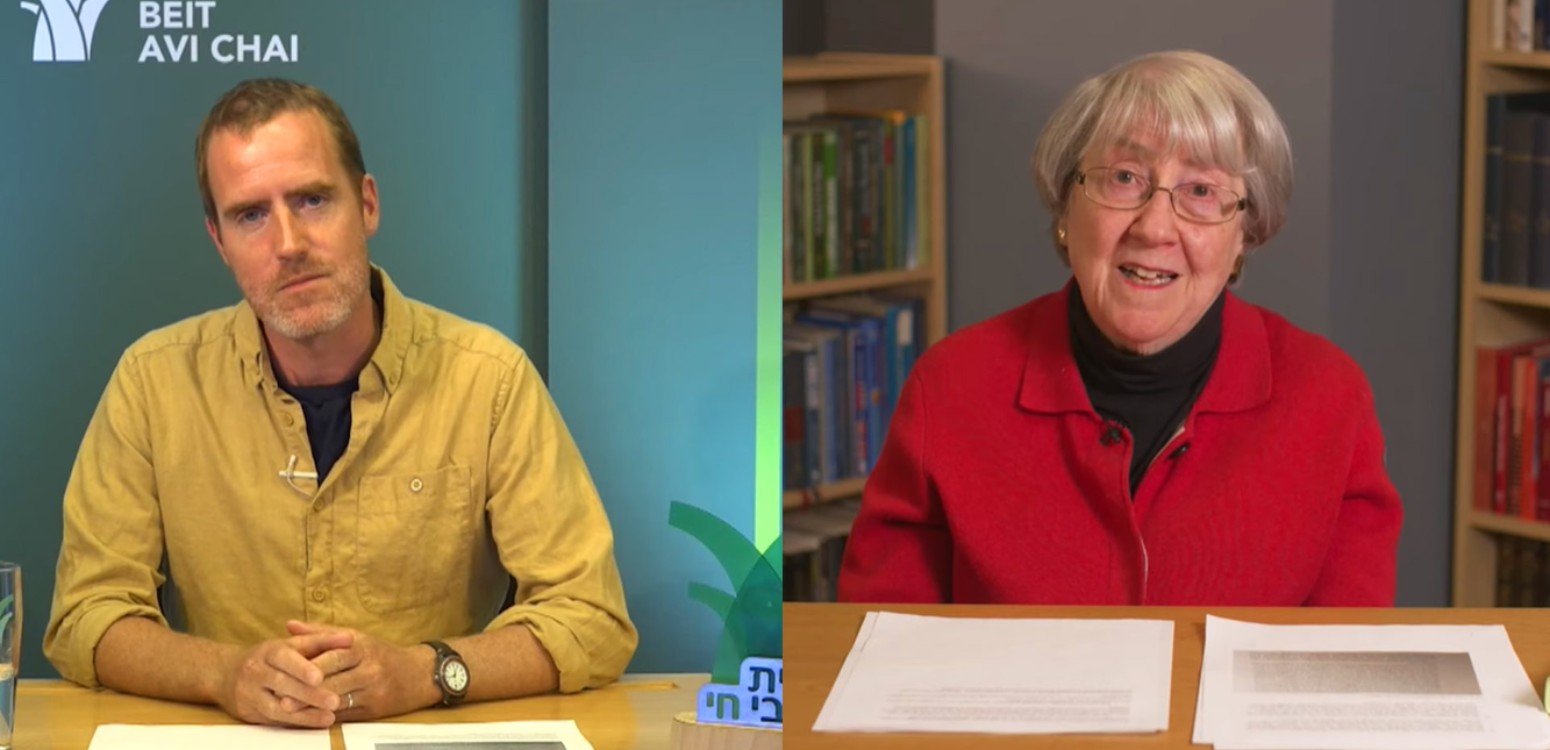
Goldstein’s lecture series at Beit Avi Chai, “A World Written in Judeo-Arabic,” recovers this lost world, exploring everything from Sa’adia Gaon’s groundbreaking Torah translation to the intimate letters preserved in the Cairo Genizah, revealing a sophisticated Jewish civilization that thought, prayed, and argued in Arabic for centuries.
The rich literature that Jews wrote in Arabic
Goldstein’s path to studying Judeo-Arabic began when she was a child. “I loved Arabic music and the way the language sounded,” she explains. Growing up in the United States, her exposure was limited to visits to Israel and cassette tapes borrowed from her local library, but the connection remained. At eighteen, she spent a year in Jerusalem at the Hebrew University, where she began to study Arabic informally.
Her epiphany came at Harvard, where she had initially enrolled to study physics. In her second year, she took an elective on the history of the Jews of Spain. “I had good Hebrew from my year in Israel, I had very good Spanish, and I was learning Arabic. I realized that I had discovered what I really wanted to study.” She switched to Near Eastern Languages & Civilizations, focusing on medieval Hebrew poetry. A scholarship to Cambridge introduced her to Judeo-Arabic texts from the Cairo Genizah, where she discovered “the rich literature that Jews wrote in Arabic.” The chance to “illuminate periods in Jewish history that really needed work” led her to pursue a doctorate at the Hebrew University.
Translating the Torah into Arabic
One of the most influential works ever written in Judeo-Arabic was Rabbi Sa’adia Gaon’s Tafsir, his translation of the Torah from the early tenth century. To understand why this was revolutionary, we need to understand what came before it. Jews had long relied on Aramaic translations of the Bible, originating during the time when Aramaic was their everyday language. “By the time Sa’adia Gaon was active, Jews had been Arabic speakers for a century or two and weren’t able to understand the biblical Hebrew or the Aramaic translation anymore,” Goldstein explains.
The intellectual world around them had been transformed since the Arab conquest. “The greats of world civilization had been translated into Arabic – Aristotle, astronomy, everything,” Goldstein notes. Greek philosophy and science were now accessible to Arabic readers. “Gaon’s revolutionary act was to put Jewish texts into Arabic and to speak about Judaism in a rational way that suited contemporary philosophy and theology.”
This was a bold move. “Jewish leaders before him had refused to do the translation,” Goldstein emphasizes. But Sa’adia “realized that to preserve interest in Judaism and respond to the needs of the community he needed to start writing in Arabic and to translate the Torah into Arabic. It was a striking success.” Sa’adia was already a major political leader, and his translation quickly became the standard. Even Christian communities adopted his translation. He also “established the way people should write Judeo-Arabic” as he established what became the classic way to represent Arabic’s 28 letters using Hebrew’s 22-letter alphabet. “It was adopted very quickly,” Goldstein concludes.
The Cairo Genizah’s randomness
While Saadia’s Tafsir represents the height of Judeo-Arabic literary achievement, the Cairo Genizah reveals its everyday reality. Found in a storage room in the Ben Ezra Synagogue in Cairo where worn-out papers with God’s name on them were deposited rather than destroyed, it contains hundreds of thousands of textual fragments spanning centuries. “It’s not an archive because it’s completely haphazard,” Goldstein explains. “It is unparalleled in any other civilization.”
The Genizah’s randomness makes it so valuable. “It doesn’t just tell us about daily Jewish life in Cairo; it also preserves merchants’ letters, everyday notes, and everything in between, that nobody would have thought to save.” The cache is crucial not only for Jewish historians but also “for Muslim historians, maritime historians, and more. It’s the actual nuts and bolts of daily life – nobody would have deliberately archived it.”
Among the most moving discoveries are voices typically excluded from history. “You can learn what women had to grapple with,” Goldstein says. “You also hear about powerful women.” Another genre she highlights is petitions: “the voices of the ordinary people that wouldn’t have been preserved in elite sources. This is very moving.”
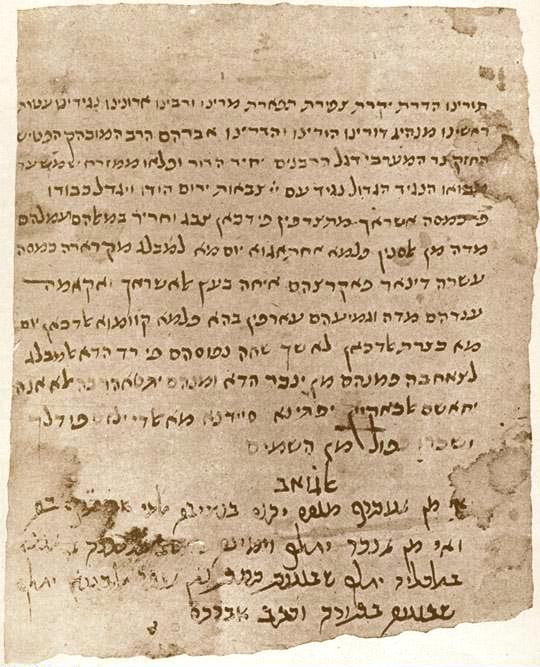
Cairo Genizah Fragment, written in a Judeo-Arabic dialect\ Wikipedia
Arabic was the default for anything intellectual
Throughout this period, the relationship between Arabic and Hebrew was complex and sometimes contentious. For three or four centuries, Arabic was “the default for anything intellectual,” Goldstein explains. This created anxiety, especially in Spain. “There was a growing awareness of the dangers of abandoning Hebrew. The scholars were for the most part native Arabic speakers who wrote prose in Arabic, but they began to write a new kind of poetry in Hebrew that was woven into daily life, writing directly about their Jewish experience and the importance of Hebrew.”
The return to Hebrew was gradual but decisive. “Works in Judeo-Arabic that weren’t translated in the twelfth and thirteenth centuries largely fell out of usage.” Many passed into oblivion, while Saadia Gaon’s work and others in Judeo-Arabic were preserved by Yemenite Jews, who later brought some of them to Israel. Karaite communities also preserved Karaite works in Judeo-Arabic. But there’s “definitely a preservation problem after the thirteenth and fourteenth centuries, even though these works were groundbreaking for their time.”
Changing how we think about Jewish identity and language
So why should contemporary Jews care about this lost world? For Goldstein, the stakes are high. Skipping over this period means misunderstanding Jewish history. “It was ninety percent of the global Jewish population from 900 to 1200 or 1300,” she notes. “If you want to read Bible commentary – the philological, rationalist, scientific view of the Bible, or the contextual approach – that didn’t come from nowhere.” The methods and genres that are familiar to us today were forged in the Judeo-Arabic crucible.
Most importantly, though, recovering this history changes how we think about Jewish identity and language. “It’s crucial that people know Arabic is not foreign to us as Jews,” Goldstein says. “It’s part of our heritage. It’s not the language of others; it’s also ours and it’s part of our history. It’s essential to know that.”
In an era when Arabic is often perceived as alien or threatening to Jewish identity, understanding the Judeo-Arabic past offers a more nuanced view. For centuries, Arabic was the language in which Jews explored their deepest religious and philosophical questions. It was the language of their daily lives, their correspondence, their scholarship. Recovering this heritage doesn’t diminish Hebrew’s centrality to Jewish life but enriches our understanding of how Jewish civilization has always thrived across linguistic boundaries. “It’s an essential and integral part of our bookshelf. If we’re not aware of this body of literature, we’re missing out,” Goldstein concludes.
For more, see Prof. Miriam Goldstein’s series at BAC, “A World Written in Judeo-Arabic: From Sa’adia’s Tafsir to al-Andalus” (in English).
Main Photo: Khan Al-Franj Saida\ Wikipedia
Model.Data.ShopItem : 0
8